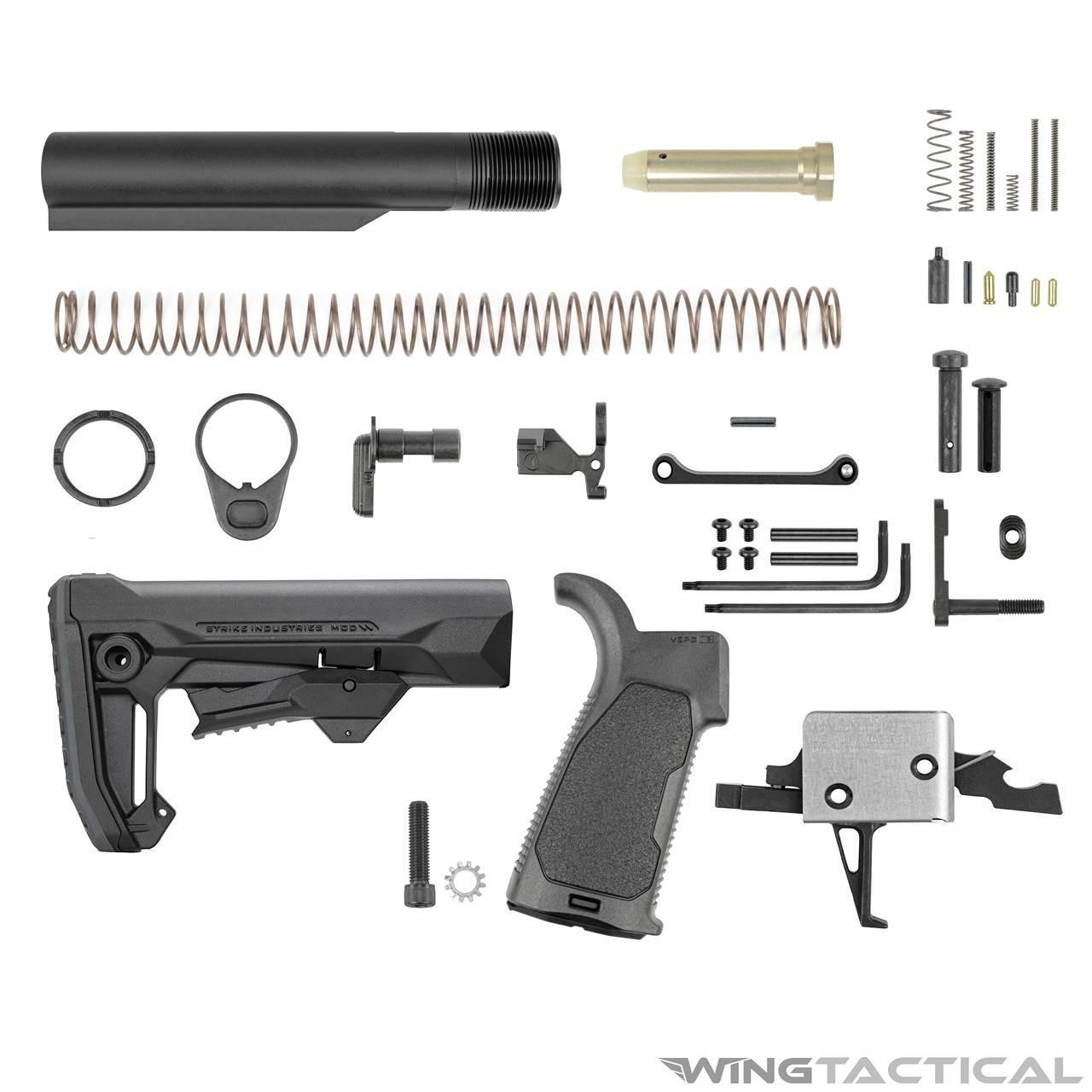
- The Lower Receiver contains most of the moving parts for an AR-15
- They are divided among the buffer, trigger, and internal assemblies
- Many of these parts are customizable, but do not need to be
Knowing what goes into a lower receiver is the first step towards fully understanding the platform and being able to upgrade it effectively. This knowledge allows you to more easily diagnose potential issues with your AR-15 and identify where you can improve the gun’s function.
But first we’ll cover what a lower receiver is.
What Is a Lower Receiver?
The lower receiver is the “bottom half” of an AR-15. It typically features a machined piece of aluminum and is often serialized. It holds the various small parts that make the AR-15 run. These include the following:
- Buffer tube
- Buffer Spring and Buffer
- Castle Nut
- End Plate
- Buttstock
- Lower Parts Kit
- Trigger Assembly
- Pistol Grip
Buffer Tube
One of the most notable projections off the back of the lower receiver, the buffer tube connects to the lower receiver by a circular threaded section. It performs the vital tasks of housing the buffer spring assembly and being the platform that the buttstock attaches to.
The buffer tube doesn't get many upgrades compared to other sections, but a few are floating around. Many of which focus on AR pistols rather than AR-15s.
Buffer Spring and Buffer
This is the heart of the AR-15’s recoil system. The spring and buffer of the buffer assembly balance out the recoil impulse from firing. The spring helps slow down the buffer, allowing it to build up enough energy through compression to return the bolt carrier forward.
The buffer itself acts like a cushion for the bolt carrier. Heavier buffers allow for the bolt carrier to slow down more efficiently before being pushed back into place. If both the spring and the buffer are improperly installed, the retention pin can chew up the buffer face.
Castle Nut
The castle nut is a large nut that screws onto the rear section of the lower receiver. Its entire purpose is to secure the buffer tube in place. If you have a poorly installed castle nut, the buffer tube can start to rotate in its position. This leads to unnatural wear and other damage to your lower receiver.
Properly installing and staking the castle nut will save a lot of headaches down the road. A seemingly simple task that many low-budget options can forget to do. If you are assembling your own AR-15, be sure to install the castle nut properly.
End Plate
The end plate of an AR-15 lower helps lock the castle nut and takedown pin detent in place. This part is designed to ensure the castle nut does not come loose. This, in turn, ensures that the whole buffer tube does not rotate.
Most rifles with a collapsible buttstock use an end plate. Some end plates even have sling mounts built into them for those who want more variety in the placement of their attachment points.
Buttstock
Now the buttstock of modern AR-15s can be easily swapped out for a wide variety of designs. Most of them are designed to be used with a standard buffer tube and are secured with a detent within the stock itself. This allows for multiple lengths of pull to fit the stock to the shooter.
The buttstock is one of the most customizable options on an AR-15, just like the pistol grip and the trigger assembly.
Lower Parts Kit
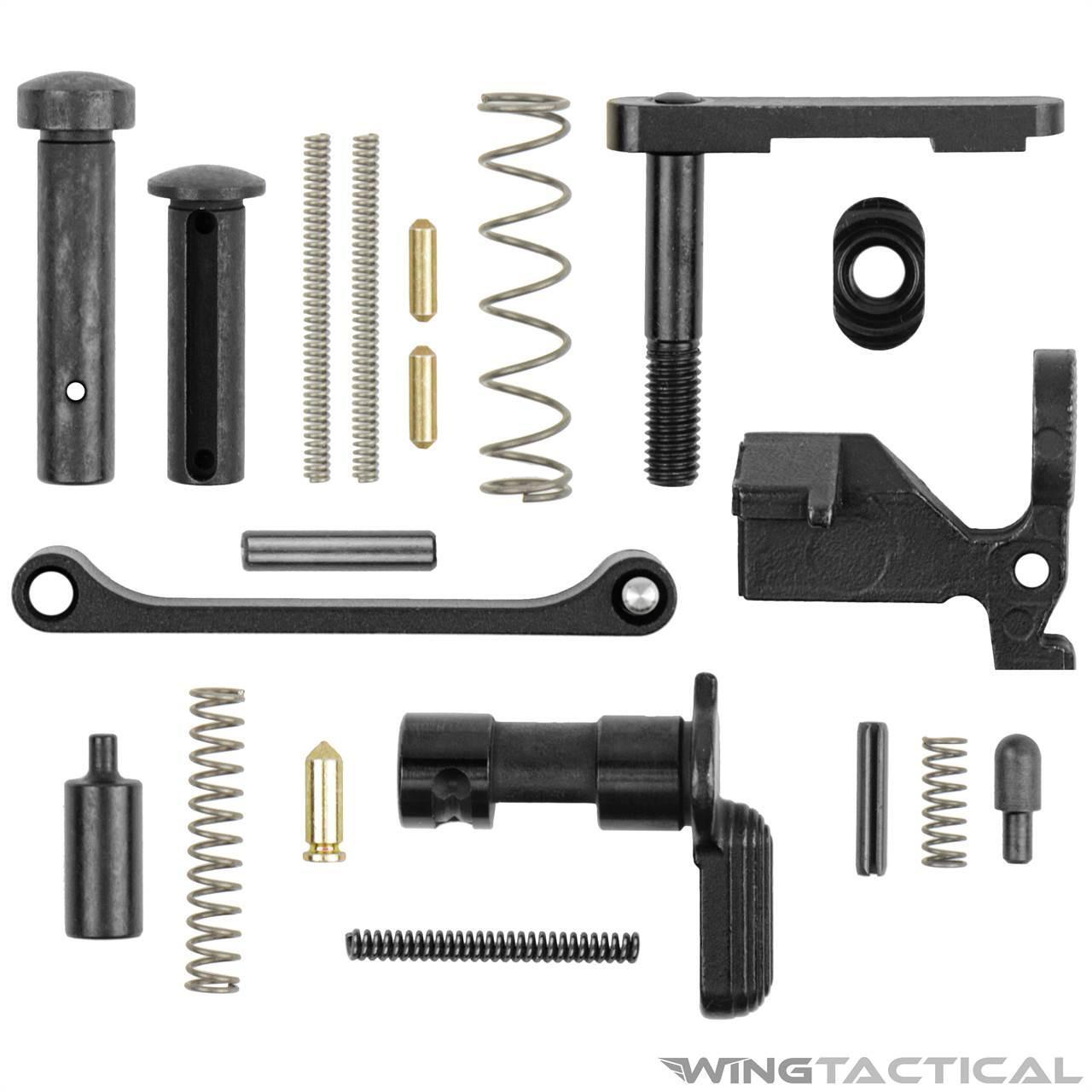
Lower parts kits contain all of the smaller, easily lost parts of the receiver. This includes the retention pins, magazine release, bolt release, takedown detents, bolt catch pins, and too many springs that will jump out of the gun if you are not careful.
Additionally, items like the safety selector, roll pins, and various plungers are included in this section. All of these lesser-recognized parts help make sure your gun is running smoothly. We often take them for granted, and they tend to get overlooked during the upgrade process.
Trigger Assembly
The trigger is one of the more familiar sections of the lower receiver. People generally will focus on upgrading or swapping out the trigger for better performance. Most of the trigger sits inside the lower receiver, with the trigger shoe protruding into the trigger guard section.
Whether it is a normal trigger style or a cassette/drop-in trigger, better performance can be had with an upgraded trigger beyond the stock mil-spec design. When it comes to lower receiver upgrades, the trigger is near the top of the list.
Pistol Grip
The last piece of the puzzle is the pistol grip. From the classic A2 pistol grip to modern Magpul and Strike Industries options, there is a grip for you. The pistol grip mounts behind the trigger area with a screw within the grip itself.
This allows it to be easily swapped in and out for other designs, making it one of the easier upgrades to get.
Conclusion
Now that you know what goes into a lower receiver, you can now consider upgrading some of your current rifle’s parts or get one of our lower receiver bundles for your next build. As long as the parts are of good, reliable quality, there really are no wrong answers. That’s why we only provide parts and accessories we would use ourselves.
If you need help with selecting your upgrades or have other questions, please contact us through our contact form. Our experts are ready to help as best they can.