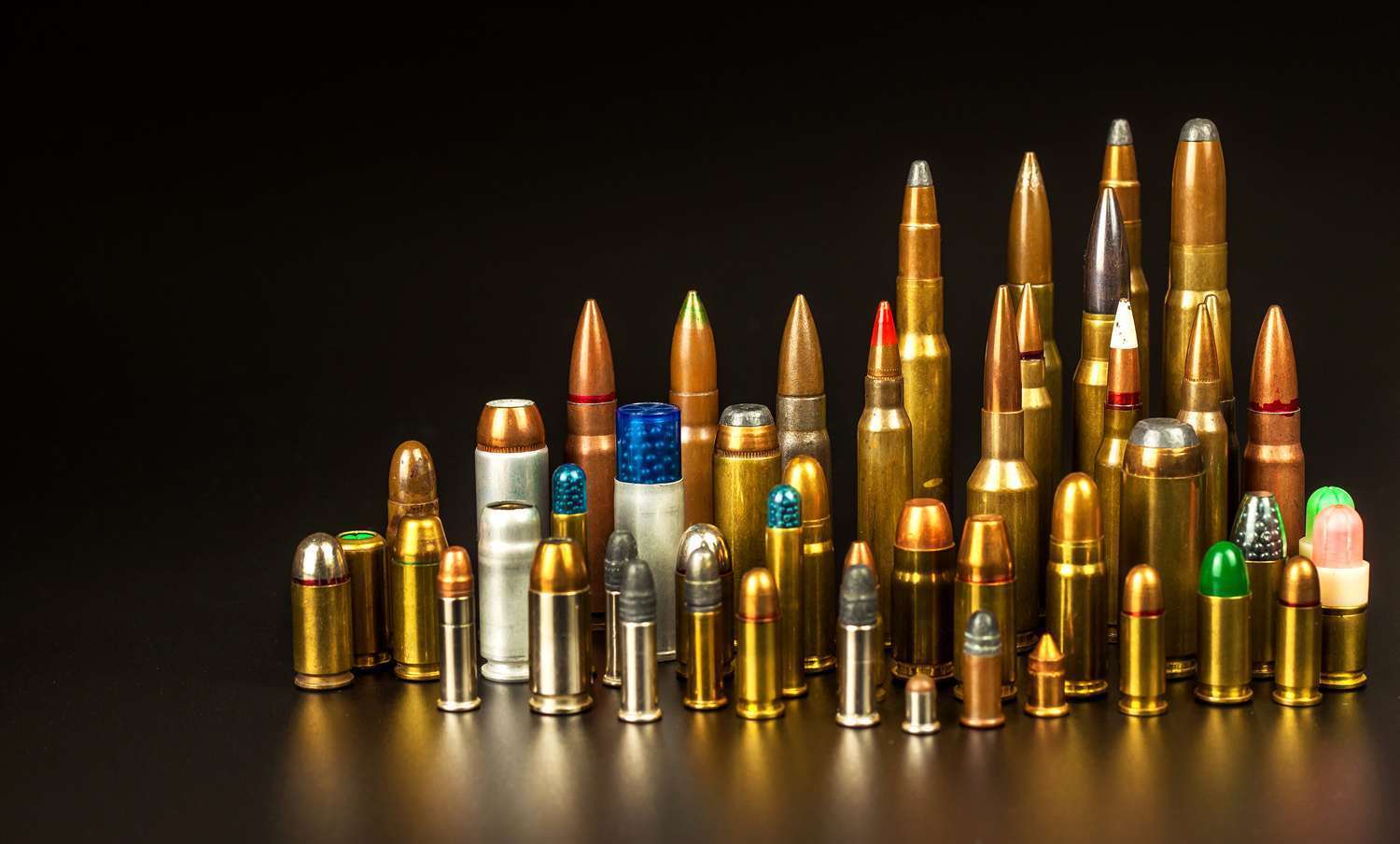
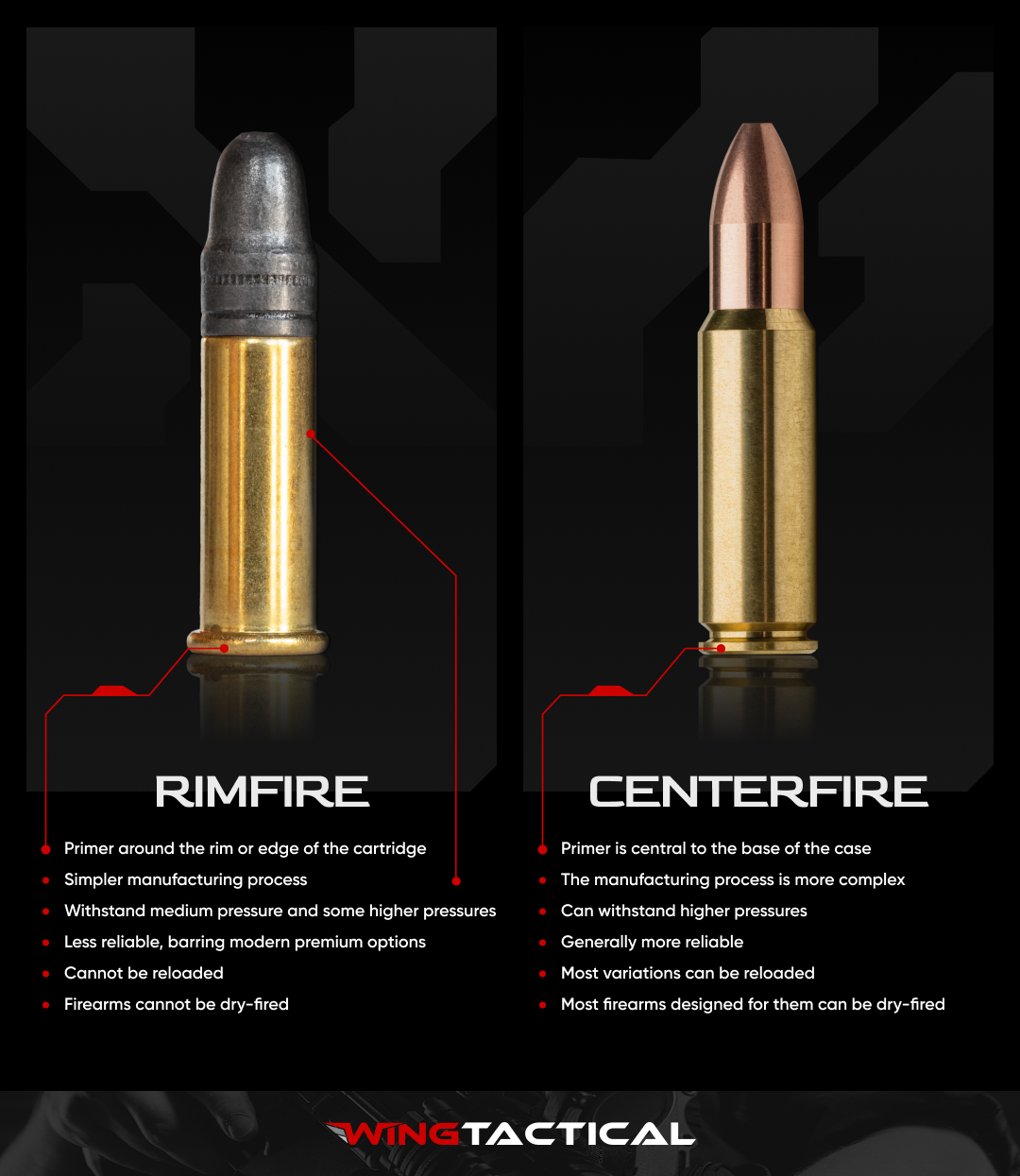
- The primer location is the difference between rimfire and centerfire cartridges
- Rimfire generally features two-prong firing pins
- Centerfire features single-point firing pins
- Centerfire tends to be more reliable
- Rimfire tends to be more cost-effective
There are many ammunition options on the market, which raises a few interesting questions. Some of these questions are “What is the main difference between centerfire and rimfire ammunition?” and “What are their uses?”
These questions will be answered, in addition to some other things you should know about these different styles of ammunition.
Differences Between Rimfire vs Centerfire
So what is the main difference between centerfire and rimfire ammunition? The primary difference between rimfire and centerfire is where the primer is located. All cased ammunition uses a primer to ignite its propellant.
If the primer is in the rim of the cartridge, it is a rimfire round. If the primer is in the center of the case’s base, it is a centerfire round. This translates into different firing-pin styles for guns that use these rounds.
Rimfire guns tend to use two-pronged firing pins to improve ignition reliability. This makes the gun unable to be dry-fired, as it increases wear on the pins. This can cause the pins to break.
Centerfire guns can generally be dry-fired, but some designs may have the firing pin contact the frame, which leads to greater wear. It is generally considered safer to dry-fire a centerfire gun.
With this in mind, let’s look at the broad scope of rimfire and centerfire ammunition.
Rimfire Cartridges: Development, Nuances, and Modern Use
Rimfire cartridges were invented by Louise-Nicolas Flobert in 1845. At the time, it was one of the most consistent metallic cartridge options. From there, it would grow into many different calibers but ultimately settle on small-caliber projectiles like .22 Long Rifle and .17 HMR, for example.
Rimfire Pros
Due to the lower manufacturing cost, rimfire is extremely common. It is also considered a “civilian” cartridge type, which makes it easier to source, stockpile, and use in legally restrictive areas.
Options like the .22 Long Rifle offer affordable target practice and are effective against small game and pests. This makes them very utilitarian in terms of overall use.
Rimfire Cons
Due to the primer placement, ignition of rimfire cartridges can be difficult. Combined with lower quality, mass-produced rounds result in a higher rate of dud or nonfunctioning ammunition. This can be mitigated by purchasing higher-quality options.
Non-jacketed bullets and shorter-than-ideal barrels also produce more fouling. This will take the form of lead and carbon fouling. Regular maintenance will easily mitigate this.
Rimfire Uses
Unlike centerfire cartridges, rimfire has a much narrower use case. These are often relegated to activities such as small-game hunting, pest control, and target practice. Especially for examples like .22 Long Rifle, .22 Magnum, and .17 HMR.
Some modern .22 Long Rifle options are designed for self-defense, but these are not the most common loadings available.
Centerfire Cartridges: Development, Nuances, and Modern Use
Conceptually, the centerfire cartridge would appear in the early years of the 1800s, with the style of centerfire we know today only becoming a reality in the 1850s. From there, the designs and methods would be refined throughout the 1900s and become the staples they are today.
Cases can be rimmed or rimless, but all of them will feature the central primer on the base of the case.
Centerfire Pros
When compared to rimfire cartridges, centerfire options can handle higher pressures, are easier to make consistent, and can be reloaded. This type of ammunition is the standard for the modern gun market and will remain the primary option until caseless ammunition is fully developed.
Centerfire designs are reliable even in their more affordable variants, making them the go-to choice for most. There is a higher risk of duds with some mass-produced ammunition, but this is usually limited to specific batches or companies with poor quality control.
Centerfire Cons
The largest negatives of centerfire cartridges are the manufacturing process. It is a slightly more complex process to manufacture a centerfire cartridge (primarily due to the case angles) than to make a rimfire cartridge. This is largely a minor inconvenience with modern methods.
Additionally, centerfire cartridges tend to be rimless, which means they need properly working extractors for consistent ejection. Most modern options have figured this out, but it is worth being aware of.
Centerfire Uses
The modern market is flooded with centerfire cartridges. They are used for pistol, rifle, and shotgun rounds. There are hundreds of variations, with some being specifically designed for self-defense, competition, or recreation.
Chances are, the next rounds you pick up will be centerfire. Especially if you are using a modern semi-automatic. If a shooting task needs to be done, there is a centerfire cartridge for it.
Closing Thoughts
The answer to “what is the main difference between centerfire and rimfire ammunition” is primer placement. This simple answer does not cover the care and use of the guns that use these different types of ammunition.
Both rimfire and centerfire ammunition have their place in the modern world. Knowing how they differ, as well as their strengths and weaknesses, makes it easier to select the right ammunition for your situation. Whether that's target practice and hunting, all the way up to competition shooting or self-defense, knowing what you need is vital.
If you don’t know what you need, feel free to contact us, and our resident experts will help you select the items to achieve your goals.