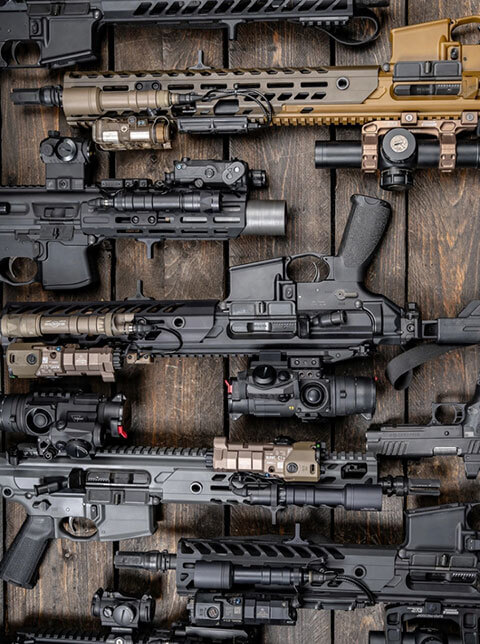
- Sights, triggers, and buttstocks are the easiest upgrades
- Buffers and gas systems are the most technical upgrades
- Triggers are the most likely first upgrades
- Sights are the most useful upgrade
What upgrade should you choose first? This is one of those questions that has to be answered with a “It depends.” Your needs and wants will differ from someone else’s. And if this is your first time upgrading your AR-15, the choices and options will seem endless.
So we are going to cover some top upgrades to consider for your AR-15. But first, we need to cover what we mean by upgrades.
Upgrade Parameters
In this article, we will look at upgrades that directly impact an AR-15's performance. While this would technically include pistol grips, we are not going to cover them, as they are relatively easy to swap in and out. That and most people can work with the A2 style for their basic shooting needs.
These upgrades will improve the rifle’s performance in how you interact with it or how it functions in some way that will be better than a stock rifle.
Sights
The upgrade with the most impact will be improved sights. Whether it is a red dot, a prism, or a magnified optic, being able to aim more easily will impact your ability to hit targets. While iron sights are still a capable tool, they start to have diminishing returns after a while.
The outside world, and even the range, will have varying levels of light and distance you will have to deal with. An improved optic will help mitigate this. Modern optics are easily installed and come in every type, style, and price point you could desire.
Triggers
The second most impactful upgrade is the trigger. A mil-spec trigger sometimes has a lot to be desired. Some people find them gritty or too heavy depending on your preferences. Swapping out the trigger for another version with a different trigger shoe, stage-style trigger, or trigger weight can make the gun more comfortable to shoot.
Just like the optic, the right trigger for you is very subjective. As long as the trigger is reliable and has the features you want, it will be a good upgrade. Some triggers are physically faster than others, while some options have one or two stages to the trigger pull. It all comes down to what you like.
Buffers
Replacing your buffer and buffer spring is the first technical upgrade you can make. Heavier buffers and stronger springs can affect the recoil impulse and the gun's reliability. If you like to run high velocity loads out of your rifle, a different recoil buffer can make the process more enjoyable.
If you use too strong a spring with ammunition that does not produce much energy, this can cause cycling malfunctions. Adjusting buffer weights will require some proper diagnostics before committing to a change. If you already know some of the gun's issues, a better buffer can be a good first upgrade.
Handguards and Rails
Swapping out your rifle's handguards or rails will change how you mount accessories on it. It can also affect how well you grip the forend. Most rifles on the market come with some form of Picatinny or M-LOK mounting system. This is fine, but some are just too thick or heavy for some people, while others may not want a featherweight forend.
For most, the only thing that would need to be changed on an AR-15’s forend is the length of the rail. Free float rails are becoming the standard for many rifles, which removes some of the issues of impact shifts that earlier designs had, which in turn makes rails more of a taste question than a performance one.
Buttstocks
If you are looking for one of the quickest upgrades, a different buttstock is the way to go. Some stocks can be swapped out without tools, while others require more involvement. A comfortable stock with specific features can improve your shooting experience.
This comes down to cheekweld, stock angle, and even storage options depending on the style you select. Some models offer a high degree of customization in their standard models, while others are almost unchangeable.
Muzzle Devices
Muzzle devices are a little tricky for some upgrades. Once other upgrade options have been ruled out, the muzzle device becomes the next possible choice. Some individuals do not want the performance of an A2 birdcage, and that is fine.
Choosing a different muzzle device helps modify the rifle’s recoil pattern and even tone when shooting. Most muzzle device changes involve selecting a suppressor, since many options on the market serve as suppressor hosts.
Some options provide better energy dispersion, while others mitigate flash more effectively. Depending on your needs and use case, you may need to try some devices before settling on a specific model.
Gas systems
An AR-15’s gas system is one of the more niche upgrades you can get. This is because of how a gas system balances reliability with performance. If a rifle is undergassed, it may not cycle properly. If it is overgassed, it will cause unnecessary wear while providing a certain level of reliability (It will cycle through dirt and debris).
Adjusting, tuning, or otherwise changing your gas system will let you manage the recoil impulse and just how much gas the system takes while shooting. Tuning a gas system applies more to full-auto and suppressed guns than to the standard AR-15, but it is still on the list of early upgrades.
Closing Thoughts
No matter what, your upgrades reflect your needs and desires. Whether that means a simple optics addition or something more intense like tuning the gas and buffer systems, your rifle should fit you.
If you are having a hard time selecting your first upgrade or need guidance on which other accessories you might need, reach out to our experts via our contact form.